

Estimate your energy savings with the energy savings calculator
Energy savings calculation: estimate in seconds the savings you can achieve on your networks (steam, hot water, thermal fluids). Quickly identify energy losses in your installations and discover the optimisation potential with high-performance thermal insulation.
Try our energy savings calculator for free
Simulate your savings now
Paramètres techniques
Renseignez les données de base de votre installation pour calibrer le calcul thermique.
💡 La résistance thermique du matelas est calculée automatiquement en fonction de la température du fluide. L'épaisseur par défaut est 60 mm (laine de verre).
Points singuliers — Filetage
Indiquez le nombre de raccords sur filetage par DN présents dans votre installation. Laissez 0 si non concerné.
| DN | Ø extérieur (mm) | Nombre de PS |
|---|---|---|
| DN 15 | 21 | |
| DN 20 | 27 | |
| DN 25 | 34 | |
| DN 32 | 42 | |
| DN 40 | 49 | |
| DN 50 | 60 | |
| DN 65 | 76 | |
| DN 80 | 90 | |
| DN 100 | 114 | |
| DN 125 | 140 | |
| DN 150 | 168 |
Points singuliers — Brides
Indiquez le nombre de raccords sur brides par DN présents dans votre installation. Laissez 0 si non concerné.
| DN | Ø bride (mm) | Nombre de PS |
|---|---|---|
| DN 15 | 95 | |
| DN 20 | 105 | |
| DN 25 | 115 | |
| DN 32 | 140 | |
| DN 40 | 150 | |
| DN 50 | 165 | |
| DN 65 | 185 | |
| DN 80 | 200 | |
| DN 100 | 220 | |
| DN 125 | 250 | |
| DN 150 | 285 |
Points spécifiques
Renseignez les équipements à géométrie particulière présents dans votre chaufferie.
Vos résultats
Renseignez votre email pour recevoir le rapport détaillé de votre bilan d'économies.
Détail par catégorie
Paramètres utilisés
Notre équipe vous accompagne
Un expert Calomatech prendra contact avec vous pour affiner votre projet d'isolation.
14120 Mondeville, Normandie
A reliable estimate based on real data: energy savings calculation
A tool co-developed with energy performance experts

This energy savings calculator was co-developed in partnership with Isokap, our specialist engineering consultancy partner in industrial energy audits, energy management and decarbonisation.
It supports companies and local authorities in optimising their energy performance and reducing their costs and carbon footprint.

Thanks to the expertise of its founder, Flavien Picot, we were able to develop a reliable, accurate tool tailored to real-world operational challenges.
This collaboration enables us to provide a relevant estimate, based on real data and a proven technical approach to calculating energy savings.
Together, Calomatech ISOKAP offer a unique approach
MEASURE
PRIORITIZE
ACT
OPTIMIZE

how to optimise your heat losses
Energy savings calculator
In industry, heat loss represents an invisible but significant cost.
Uninsulated or poorly insulated networks and specific components can account for up to 24% of total energy losses across an entire installation.
Our tool enables you to:
-
Assess your current energy losses
-
Estimate savings after insulation
-
Prioritise actions with a high return on investment
-
Justify your energy efficiency projects


The objective: to give you a clear and quantified vision of your site’s energy optimization potential.
REDUCE ENERGY LOSSES
A strategic challenge for industries and commercial buildings
The energy savings calculator is a strategic tool for industrial sites and commercial buildings.
It allows you to:
- Understand your energy losses
- Quantify them precisely
- Act effectively
A concrete approach to improve your energy performance and accelerate your transition towards a more sustainable company.
Co-developed by Calomatech and ISOKAP, our energy savings calculator was designed to offer a simple and actionable initial estimate of the savings achievable on your installations and networks.
In just a few clicks, it allows you to:
- Calculate your energy losses (kWh/year)
- Estimate your potential financial savings (€/year)
- Measure the reduction of your CO₂ emissions (kg CO₂eq/year)
- Identify the most profitable insulation actions according to your equipment
- Evaluate the return on investment (ROI) of the implemented solutions
ESTIMATE YOUR ENERGY LOSSES AND MAKE SAVINGS
How does the calculator work?
The energy savings calculation is based on the analysis of the key parameters of your installation. The parameters taken into account are:
- Fluid temperature
- Network type (steam, hot water, etc.)
- Equipment diameter and length
- Environment (indoor / outdoor)
- Current insulation level
This data is used to estimate heat losses and potential gains after implementing a suitable insulation solution.

A performance-based approach
HEAT LOSSES
Heat losses are directly linked to the temperature difference between the fluid and the environment, as well as the thermal conductivity of the materials.
ENERGY OPTIMISATION
Adding suitable insulation drastically reduces these losses by limiting heat transfer.
RESULTS
You receive a clear estimate:
-
Energy savings (kWh)
-
Financial savings (€)
-
Reduction in CO₂ emissions
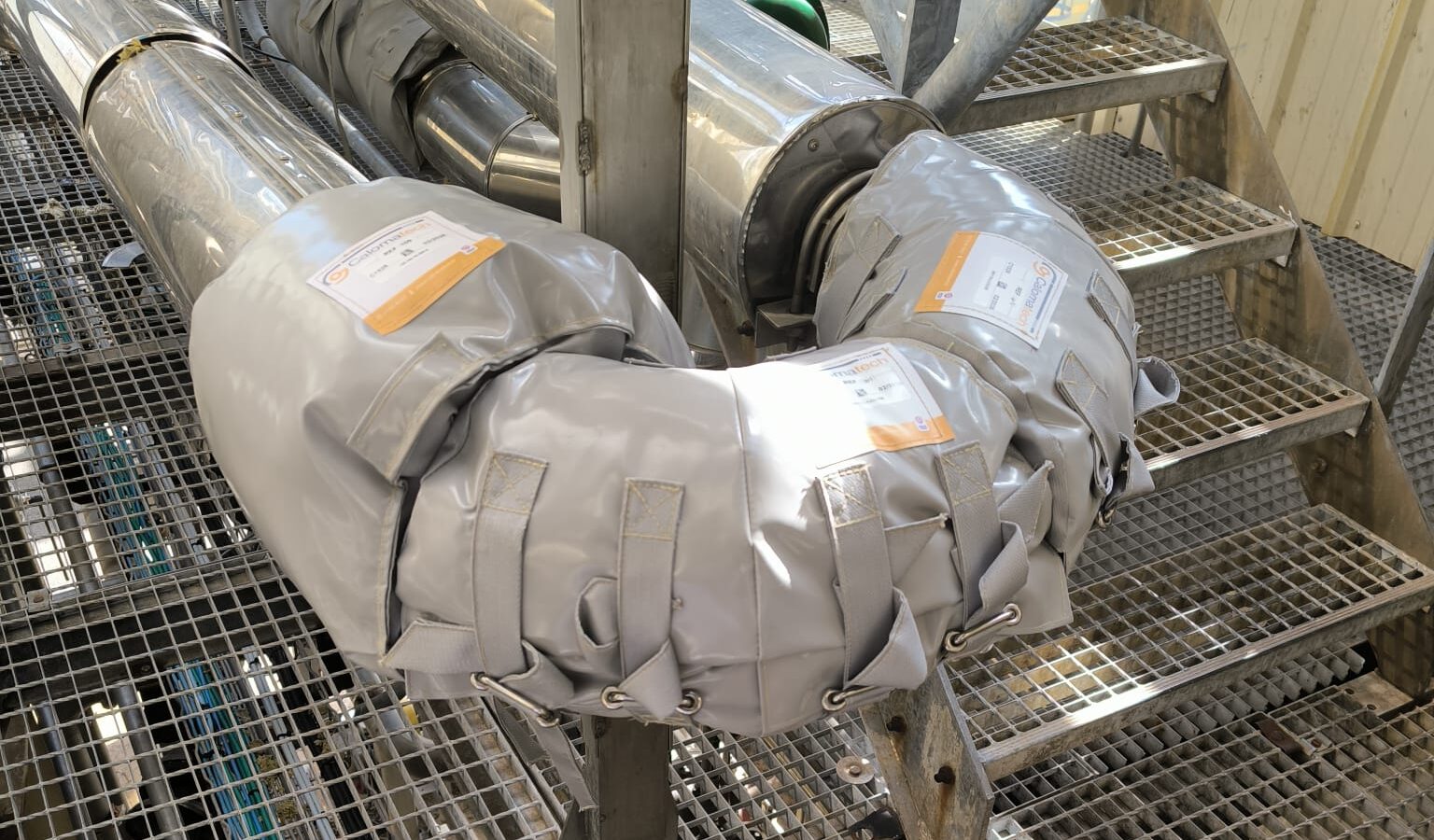
Identify invisible losses
An energy savings calculator allows for a quick estimation of achievable energy savings on a production site, boiler room, technical room, etc. It is a strategic decision-making tool for companies wishing to improve their energy performance, reduce their operating costs, and limit their environmental impact.
These losses can represent several thousand euros per year.
industries and commercial buildings
Why use an energy savings calculator?
What is an energy savings calculator used for?
An energy savings calculator allows for a quick estimation of achievable energy savings on a production site, boiler room, technical room, etc. It is a strategic decision-making tool for companies wishing to improve their energy performance, reduce their operating costs, and limit their environmental impact.

How to reduce energy losses in industry and commercial buildings?
In an industrial environment, a production site, a boiler room, or a technical room, energy losses often come from leaks, poorly adjusted equipment, or a lack of monitoring of installations. The result: energy consumed but not used.
To effectively reduce these losses, it is essential to quickly identify critical areas and implement concrete actions on site.
What are the most effective actions to reduce a building’s energy consumption?
- Leak detection and repair
- Control and optimization
- Improvement of thermal insulation for networks and equipment
- Waste heat recovery
- Monitoring and tracking of energy consumption
Thanks to our industrial energy savings calculator, you can identify in minutes:
- The most energy-intensive items
- Achievable savings
- Actions to prioritize
Quantify your industrial and commercial energy savings
The calculator transforms a technical problem into a financial lever:
- Estimation of gains
- ROI calculation
- Projection of savings
Improve the technical performance of your production site and buildings
By objectifying the data, you can:
- Prioritize your investments
- Structure your energy efficiency projects
- Feed your energy audits
Is the energy savings calculator reliable?
Yes, it is based on the combined expertise of Calomatech and ISOKAP in thermal and energy engineering, which relies on relevant and concrete data.
ENERGY SAVINGS CERTIFICATES
Can this tool be used for the CEE premium?
The energy savings calculator can be an excellent starting point for identifying projects eligible for Energy Savings Certificates (CEE).
It notably allows you to:
- Quantify potential savings
- Identify standardized or specific operations
- Direct investments towards eligible actions

You can now calculate your eligibility for the CEE premium on our website.
Because installations and networks have their specificities
we offer you a quick estimate and a precise study
WHY CHOOSE CALOMATECH TO OPTIMIZE YOUR ENERGY SAVINGS?
Choosing Calomatech means benefiting from:
- cutting-edge technical expertise in the industry
- a concrete and measurable field approach
- support from analysis to implementation
- the ability to generate rapid and sustainable savings
The energy savings calculator is just a first step:
Calomatech transforms these estimates into real performance, serving competitiveness.


TAKE ACTION WITH CALOMATECH
At Calomatech, this type of calculator is part of a global approach: it’s not just about providing an estimate, but about transforming data into concrete levers for action. Thanks to our field expertise, we offer solutions adapted to each environment:
- Custom insulation mattresses to reduce heat losses at your singular points
- Qualified field expertise
- Comprehensive support, from needs assessment to manufacturing and installation
- An immediate impact on your energy performance
The objective: to transform your thermal losses into sustainable gains.

custom-made insulating mattresses
Up to 24% energy savings on your networks
Thermal insulation of critical points enables:
- 12% to 24% overall energy savings on a network
- A reduction in ambient temperature of up to 7°C
- Lower air conditioning costs
- Improved working conditions
a direct lever for efficiency
Optimization of industrial performance
Beyond cost savings, thermal insulation also enables:
-
Stabilize process temperatures
-
Secure installations (reduced risk of burns)
-
Improve equipment lifespan and durability
-
Reduce your carbon footprint
You can now estimate your potential savings on your equipment and networks using our tool: energy savings calculator.

FAQS
What is an insulating blanket?
The benefits of insulating blankets
- Quick to fit: Made to the dimensions and profile of the room, the insulation blanket can be fitted in a matter of seconds.
- Easy to dismantle: Likewise, it can be dismantled in a fraction of a second, so you can improve your valve maintenance times.
- Clean: The insulation blanket does not give off dust or bits of flying insulation wool when it is dismantled.
- Lightweight: As it is made from wool and fabric, it can be easily handled by one person.
- The thickness of the thermal insulation: Its flexibility makes it easier to slide the mat between a wall and a singular point where the spacing is small. This means you can isolate a larger number of points.
What parts should be fitted with an insulating blanket?
How do I choose an insulating mattress?
- Usage requirements (energy savings / anti-bulging solution)
- Environment: The location where the insulation blanket is installed plays a key role in selecting the appropriate materials. Indoors, within technical rooms, aggressive cleaning agents can damage standard insulation fabrics. That’s why we help you identify the right materials to use (such as PTFE or ATEX-certified fabrics). Conversely, for outdoor environments, weatherproof and UV-resistant fabrics are generally recommended.
- The type of fluid: The nature of the fluid (steam, hot water, superheated water and/or organic fluid) affects the thickness of the insulation in the insulating mattress.
- Temperature: The temperature of the fluid is also a determining factor in the thermal insulation of an insulation blanket. The temperature will make a pre-selection of the insulation to be used, but the technical characteristics and maximum temperature of use of the fabric must also be taken into account.

